
7 Reasons Why Meno
The Perennial Journal · Women's Health
7 Reasons You're Exhausted in Menopause — And Why It Isn't Your Hormones

SUMMARY: If you're in perimenopause or menopause and permanently tired — the kind sleep doesn't touch — everyone's first assumption is hormones. Hormones are part of it. They're just not the part causing the exhaustion. Menopause drains a second energy system that no standard blood panel measures, and that's where the tiredness is actually coming from.
Here are seven reasons it's happening — and what it takes to refuel it.
The seven reasons, in order
Reason 1The panel that came back normal only measures half of you.
“Your Labs Are Fine.” But You Don't Feel Fine.
Not exaggeration. Not "just getting older." Not something more discipline would fix.
Women between 45 and 60 describe it in almost identical words: not sleepy — heavy. Like your bones are tired.
The pattern is specific enough to be recognisable:
- You wake up already depleted. Coffee gets you to noon.
- By 2 or 3 PM you hit a wall hard enough that you can't follow a conversation.
- You read the same email three times before it goes in.
- You sit in the car a few minutes after work before you can walk into your own house.
- By evening you're cancelling plans — not because you don't want to go, but because being "on" for two hours costs more energy than you have left.
What the research found
Researchers at UCLA followed 3,100 women through menopause and found it accelerated biological ageing by about 6%. Women reporting sleep and cognitive symptoms measured close to two biological years older than their actual age.1
You're not imagining the difference. Someone measured it.
If it's this real, why hasn't a single thing you've tried touched it?
Does this sound like you?
Tick the ones that apply. Three or more is the pattern this article is about.
Reason 2Sleep restores Engine One. It can’t refill Engine Two.
Eight Hours. Still Heavy.
You have done the obvious things. Earlier nights, fewer screens, magnesium, possibly a new mattress. And you still wake up feeling as though you have already been awake for hours.
That is the part that does not fit. Sleep debt has a fix, and the fix is sleep. This does not respond to it.
The distinction women draw, almost word for word, is between sleepy and heavy. Sleepy is a signal your body knows how to answer. Heavy is what it feels like when the sleep happened and nothing got rebuilt — because the rebuilding itself costs energy, and eight hours in bed does not buy you eight hours of repair if the fuel is low.
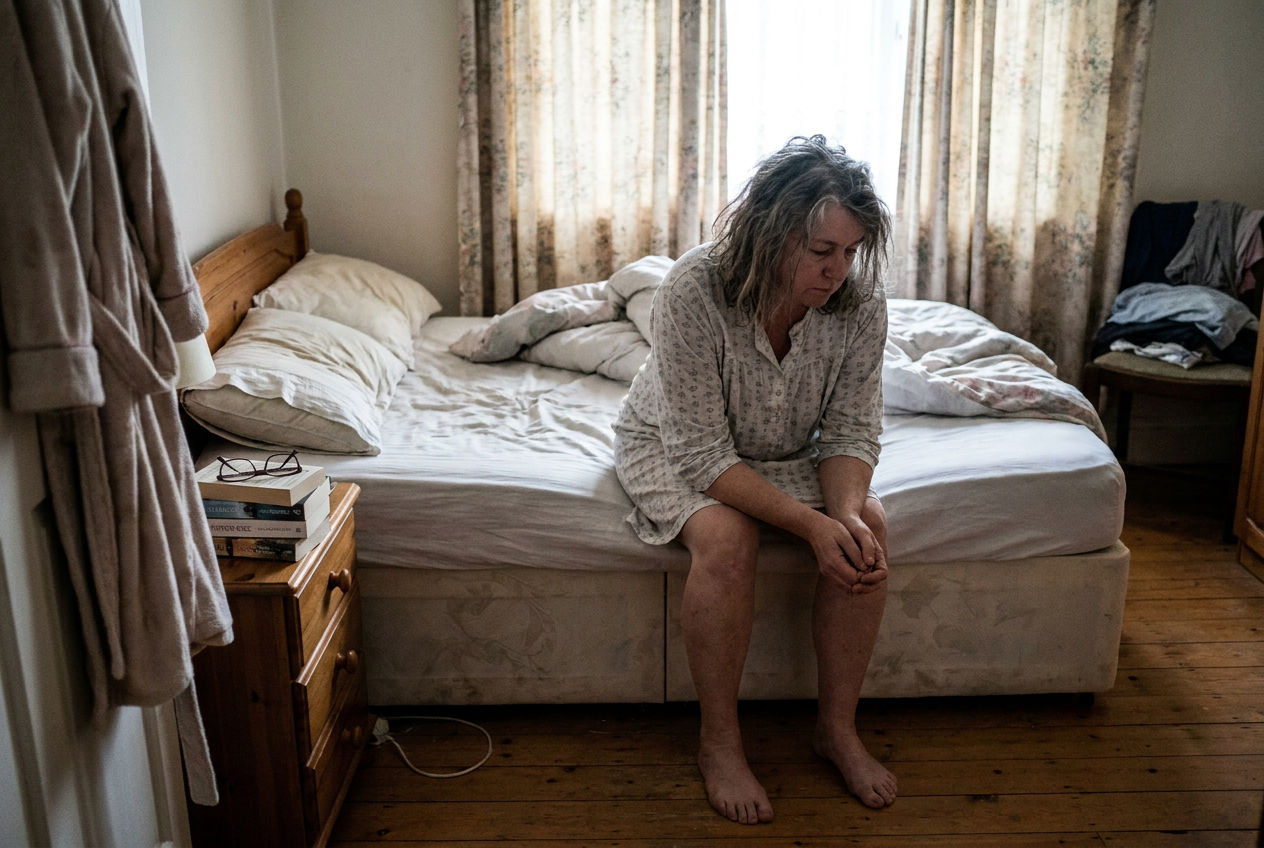
Which is how the number on your sleep tracker looks fine while you feel like this.
And the tiredness is not even the part most women notice first.
Reason 3It doesn’t present as tiredness, so you never went looking for an energy answer.
You Never Called It Exhaustion. You Called It Not Feeling Like Yourself.
Here is what keeps this hidden far longer than it should be.
If you had woken one morning obviously exhausted, you would have gone looking for an energy answer. You would have searched why am I so tired, found something about cellular energy, and arrived here two years earlier.
That is not how it presents.
What you noticed instead was that things had gone quiet. You stopped being the one who suggested the weekend away. The book club drifted. You would say yes to something three weeks out, then spend three weeks quietly hoping it got cancelled.
Women describe it in language that has nothing to do with energy at all:
I don't feel like myself anymore. Everything feels flat — even the things I used to love.

A faded version of myself. I'm not the me I remember. I look in the mirror and don't quite recognise the person looking back.
None of that sounds like a fuel problem. It sounds like a personality change, or a mood problem, or simply what happens now — so that is where you went looking.
Running on half your available energy does not feel like tiredness from the inside. It feels like becoming a smaller version of yourself. Energy goes first to what keeps you alive and last to what makes you you.
There is one more place it shows up early — and this one you can actually catch happening.
Reason 4Thinking burns more NAD+ than almost anything else, so it goes first.
Why the Words Go First
The word is right there. You can feel the shape of it. And it does not come.
So you route around it — the thing you drain pasta with — and everyone laughs, and you laugh, and underneath it you file away another small piece of evidence you are not showing anyone.

Then it is walking into a room and working out why. Reading the same paragraph four times. Losing the thread of a meeting you are chairing.
Most women assume this is memory. It usually is not. Memory is storage. This is retrieval, and retrieval is expensive.
Your brain is about 2% of your body weight and uses roughly 20% of your energy. Finding a word, holding a thought while you shape it, tracking a conversation while planning your reply are among the most energy-hungry things you do all day. When fuel runs low, the most expensive processes feel it first — so this is not your memory failing, it is the most demanding thing your body does being asked to run on less.
It is also why this frightens women more than the tiredness does. Nobody lies awake worrying about being tired.
So where did the fuel go?
Reason 5It wasn’t bad judgment. It was the wrong system.
Magnesium. Ashwagandha. Black Cohosh. HRT. Here's Why None of It Touched the Tiredness.
Most women reading this have spent a year or more, and several hundred dollars, working through the same list.
The supplement shelf
Magnesium helped you fall asleep, slightly. Ashwagandha — honestly hard to tell. Black cohosh took the edge off the flashes. The B-complex did nothing you could name.
Hormone therapy
For many women it genuinely works. The flashes settle, the mood steadies. And the bone-deep tiredness stays exactly where it was.
Doing everything right
Cleaner eating, walking more, cutting the evening wine, eleven days of a meditation app before it quietly vanished off your phone.

“I've done the ashwagandha, the magnesium, even HRT. I was napping in my car at lunch just to survive the afternoon. This was the first thing that touched that exhaustion. I actually have energy at 5 PM now — like, making-dinner-and-still-talking energy. My husband asked what changed.”
Sarah M., 52 · tried six other supplements first ★★★★★
Here's the part worth sitting with: none of that was wasted money or bad judgment. Every one of those was built for the same system, and inside that system most of them did their job properly.
You haven't been failing at this. You've been treating one of two systems — and nobody told you there was a second one.
So why did nobody tell you?
Reason 6As oestrogen falls, a second drain opens on your cellular fuel.
Hitting a Wall at 2 PM? That's Your NAD+ — Not Your Hormones.
Your body runs on two engines.
Engine One runs on hormones. Flashes, cycle, mood. It's the engine every product in the menopause aisle is built for, and the one your doctor checked.
Engine Two runs on cellular energy — and its fuel is NAD+.
NAD+ isn't a hormone or a vitamin. It's what your cells use to turn food into usable energy and to run repair. Your brain uses it to hold a thought together. Your legs use it to get you up the stairs.
It declines with age on its own — roughly 50% between 40 and 60.2
Menopause then adds a second drain on top of that:
Brain cells use more NAD+ than almost anything else in your body, which is why the fog and the word-finding usually arrive before anything else does.
A standard blood panel measures none of this. It measures hormones, thyroid, iron, blood counts — Engine One. That's how your labs come back genuinely fine while you feel like this.
Reason 7Nothing drops. The baseline moves.
Nothing Changed on Any Particular Tuesday. That’s Exactly the Problem.
This is the part that makes it so easy to keep postponing.
Nothing dramatic happens on any particular Tuesday. There is no morning where you wake up and find a step change. If there were, you would have dealt with it years ago.
What moves is the baseline. Each year starts fractionally lower than the last, and because the shift is slower than your ability to notice it, you adjust instead of addressing it. You stop booking things after seven. You do the shop on Saturday morning because Saturday afternoon is gone. You build a slightly smaller life around a slightly smaller supply, and you do not experience that as decline. You experience it as being sensible.

Which is why the honest version of urgency here is not a countdown timer.
A woman starting at 48 has less ground to make up than the same woman starting at 55. That is the whole argument.
Which leaves the only question that matters: can the second engine actually be refuelled?
See what we made for Engine Two60-day money-back guarantee · Free express shipping · Cancel anytime
Nobody Hid This From You. Nobody Was Looking.
For decades, menopause research went almost entirely into hormones. That's where the funding went, that's what got studied, and that's what filtered down into a fifteen-minute appointment.
Meanwhile, in a completely separate field, cell biologists were studying something else — and the two conversations didn't meet.
Researchers tracking cellular energy noticed that levels of a molecule called NAD+ were falling with age in everyone. But in women moving through menopause, they were falling faster than age alone could explain. When they went looking for why, they found a single enzyme — CD38 — whose entire job is to consume NAD+, and which is normally held in check by oestrogen.3
Therefore: as oestrogen falls, that enzyme is released — and the drain accelerates at exactly the moment women are told their symptoms are hormonal and nothing else.
Your doctor isn't hiding this. Most of this research is less than a decade old, and almost none of it has reached routine practice. The field simply hasn't caught up.
That gap is the reason you've been guessing.
Here's the part they did work out — and what it has to do with four o'clock in the afternoon.
Built for a Woman at 52. Not a Biohacker at 30.
You can't usefully swallow NAD+ itself — the molecule is too large to absorb intact. So supplements supply a precursor: a smaller building block your cells convert into NAD+.
Most products use NR — a real precursor with its own research. But the NAD+ trials in women, like the 2021 Science study in postmenopausal women, used NMN.

| Most NAD+ brands | Perennial | |
|---|---|---|
| Molecule used | NR | NMN |
| Studied in postmenopausal women | — | Yes |
| Dose per serving | Often 300 mg | 500 mg (tested at 533) |
| Built around menopause | No | Yes |
| Open label, no blends | Varies | Yes |
So what does that actually do for you?
Plainly: it gives your cells more of the raw material they use to make NAD+, at the stage of life when a second drain has opened on your supply. It does not touch your hormones. It doesn't replace anything you're already doing — it works on the layer underneath.
In practical terms, it supports:
- Steady daily energy — the afternoon specifically, rather than a stimulant spike
- Mental clarity and focus — the cells that run thinking are the hungriest for NAD+
- Cellular repair and recovery — from exercise, from stress, from short nights
Which stage are you in?
The drain begins in perimenopause, when oestrogen first starts fluctuating — often in your early-to-mid forties, frequently before periods become irregular. It continues through menopause and into the postmenopausal years, when oestrogen settles at a permanently lower level. There is no stage at which this stops being relevant; there's only how much ground there is to make up.
What's in it: one serving a day, two veggie capsules, 500 mg of NMN — independently tested at 533 mg per serving, above what the label claims, with heavy metals and microbials all passing. Open label. No proprietary blends, no hormones, no stimulants — and every other ingredient printed on the bottle: rice flour, microcrystalline cellulose, and the vegetable capsule itself.
Fair question at this point — will you actually feel anything?
“I Hadn't Napped in My Car at Lunch in Weeks.”
This is not a stimulant. There's no jolt on day one, and any page promising you one is selling caffeine. What customers describe is quieter, slower, and arrives in a fairly consistent order.

- Weeks 1–2 — sleep moves first. Falling asleep comes easier. The 3 AM wake-ups start spacing out.
- Month 1 — the wall softens. You get through the afternoon without needing to lie down after, and notice you didn't reach for the second coffee.
- Months 2–3 — it compounds. Words come easier. Recovery improves. You stop tracking whether it's working, because you're busy doing things you'd stopped doing.
“I was ready to accept that this was just my life now. Two months in, I realised I hadn't napped in my car at lunch in weeks. I was making dinner and still had energy to talk to my husband. I genuinely didn't think that was possible anymore.”
Jen R., 44 ★★★★★
Individual results vary — your body rebuilds on its own schedule, not on a marketing timeline. Some women notice something inside a fortnight; others need the full eight weeks. That is exactly why the guarantee runs 60 days rather than 30.
And if you turn out to be one of the women it does nothing for?
Sixty Days. Keep the Bottle Either Way.
You've already spent money on things that didn't work. It's entirely reasonable to assume this is another one. So the terms are built so that assumption costs you nothing.

Perennial NMN
500 mg NMN per serving · 2 veggie capsules daily · 60 count, 30-day supply · open label, no proprietary blends, no stimulants
Subscriptions include free express shipping and can be skipped, paused, or cancelled from your account at any time. No phone call.
The guarantee, in plain terms: take it daily and give it a fair run. If you don't feel it supporting your energy, clarity, or general wellbeing, email us within 60 days of your first delivery and we'll refund that first bottle. You don't ship anything back. You keep the bottle.
Start with Perennial NMN60-day money-back guarantee · Free express shipping · Skip, pause, or cancel anytime
Current batch status
78% of this batch is claimed. We make NMN in single tested lots rather than continuously, so when a lot goes, the next one is a few weeks out. Subscribers are filled first.
Only you can decide whether this is worth it
Honestly: if your energy is fine and none of the above sounded like you, you don't need this. Plenty of women move through menopause without ever needing to think about the cellular side.
If it did sound like you, you have three options.
- Do nothing. Entirely valid. The tiredness isn't dangerous. But the baseline keeps moving, and next year's version of this decision is made with less ground to work with.
- Work it out yourself. The research is public — Massudi, Camacho-Pereira, the UCLA cohort. Read it, then find a supplier who will publish a certificate of analysis and actually dose NMN properly. It's genuinely doable. It took us a long time.
- Try ours for 60 days. If it does nothing for you, you email us, you keep the bottle, and you're out nothing but the time.
The women who've got the most out of Perennial are the ones who were finished guessing and wanted an actual explanation. If that's you, it's here. If not, no pressure at all.
Start with Perennial NMN60-day money-back guarantee · Free express shipping · Skip, pause, or cancel anytime
Dr. Rachel Nguyen, Health Editor
Rachel writes The Perennial Journal's research desk, covering cellular ageing, menopause and the gap between what the literature shows and what reaches a fifteen-minute appointment. She reviews every claim on this page against the published source.
References
- Levine, M. et al. "Menopause accelerates biological aging." PNAS, 113(33), 2016. ↩ back to text
- Massudi, H. et al. "Age-Associated Changes In Oxidative Stress and NAD+ Metabolism In Human Tissue." PLOS ONE, 7(7), 2012. ↩ back to text
- Camacho-Pereira, J. et al. "CD38 Dictates Age-Related NAD Decline and Mitochondrial Dysfunction." Cell Metabolism, 23(6), 2016. (preclinical) ↩ back to text
These statements have not been evaluated by the Food and Drug Administration. This product is not intended to diagnose, treat, cure, or prevent any disease. Consult your healthcare provider before starting any new supplement, particularly if you are pregnant, nursing, taking medication, or managing a health condition.
